Top 10 Reasons to use LVDT Displacement Sensors
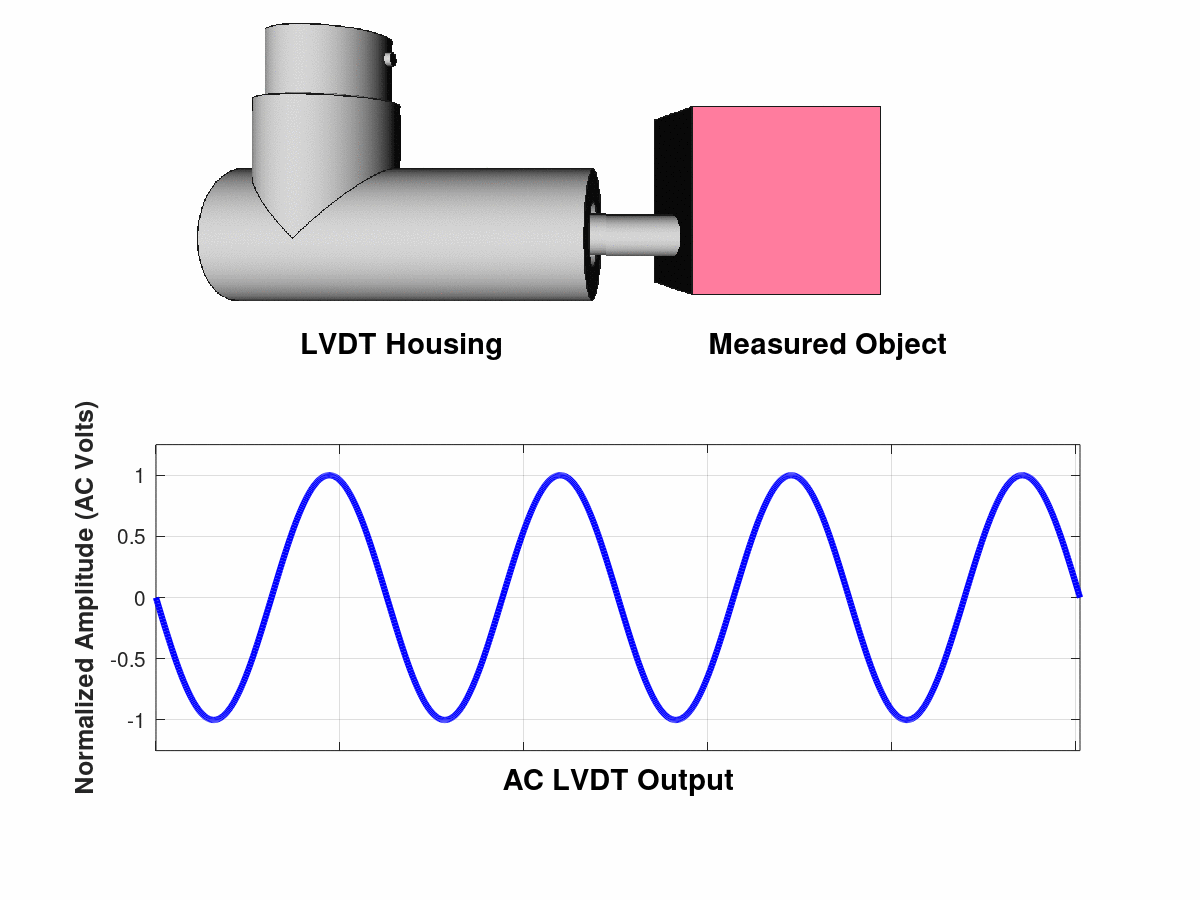
Why Use an LVDT? LVDT displacement sensors are ideal for so many applications! Here is the Top 10 list of reasons why.
1. Frictionless Measurement
No rubbing parts, no wear, no error due to stiction, no resistance. Because the low-mass LVDT core can float freely within the housing of the LVDT, there is no friction between the core and the housing. This is ideal for measurements of vibration or of systems where friction can cause a change in a dynamic response, and for measurements of structural deflection or creep where stiction can cause inaccuracies. Clearance between the core and housing also offers some tolerance for misalignment.
2. Infinite Mechanical Life
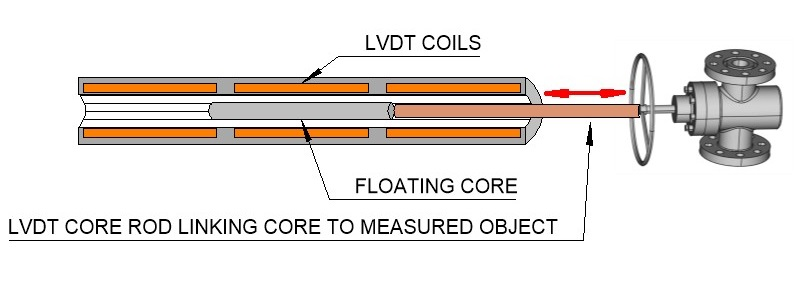
You may never have to replace this sensor, even after decades and millions of cycles. Because the LVDT has no moving parts and no friction, it has nearly infinite mechanical life as no components wear. Used to make measurements in inaccessible locations like nuclear plants, embedded in structures for strain monitoring, or installed in choke vales on the seabed, LVDTs are depended on to continue their operation many years, even decades, after installation.
3. Separable Core & Coil
Highly corrosive, subsea, and pressurized environments? LVDTs can do that. A non-magnetic barrier can separate the LVDT coil from the core, allowing the LVDT to make measurements in corrosive or pressurized environments. Frequently used in level systems, pumps, and valves, the LVDT core can be exposed to media at high pressure and temperatures while the housing and coils can be separated by a sleeve or tube made of glass, metal, or other non-magnetic materials.
4. Excellent Repeatability
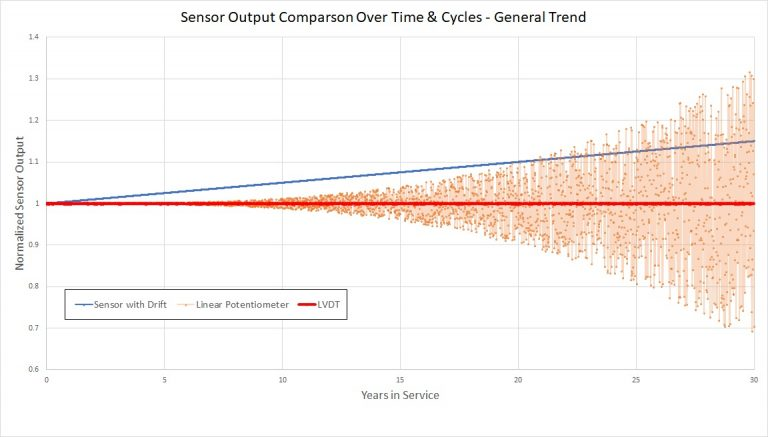
LVDTs do not drift or get noisy over time... even after decades. Often specified at 0.01% of full range or better, LVDTs exhibit excellent repeatability for any point within its range. For example, in dimensional testing or roller position where repeatability is of paramount importance, LVDTs deliver extremely consistent output at a given position. This is in contrast to most pressure sensors, for example, whose output at any given pressure drifts over time due to metal fatigue and linear potentiometers whose output can become very noisy over time due to wear, vibration, or foreign matter intrusion. This is of critical importance for structural monitoring and product thickness measuring applications where often very small movements are measured over many years.
5. Infinite Resolution
Even the most infinitesimal movements are measured accurately by LVDTs. Without stiction and the principle of being a variable transformer, the LVDT inherent makes a position measurement of infinite resolution only limited by the associated electronics. In practice, LVDTs can detect extremely small changes in position. Particularly valuable to measure parameters like dimensional quality, TIR measurements, and thermal expansion, LVDTs are capable of detecting changes on the sub-micron level.
6. Null Repeatability
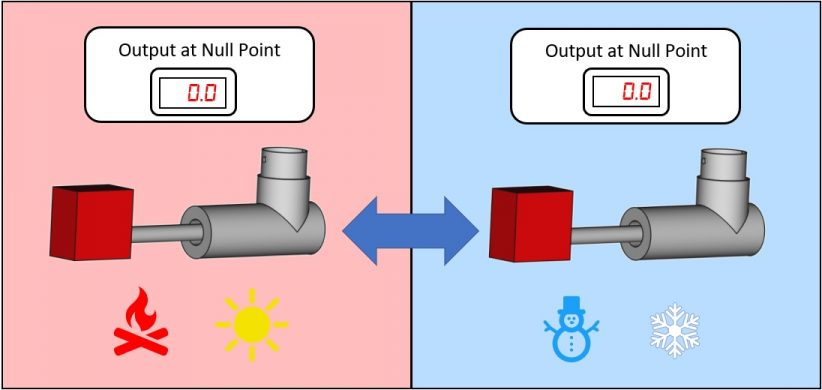
From -300°F to 1000°F , LVDTs always give you a consistent reference point. Inherent of symmetric coil design, the null point of the LVDT (the center of the LVDTs electrical range where the output is nearest to zero) is extremely repeatable. This consistent reference point becomes valuable in applications where temperature varies widely as the null point is impervious to drifts and serves as a consistent point from which calibrations are based.
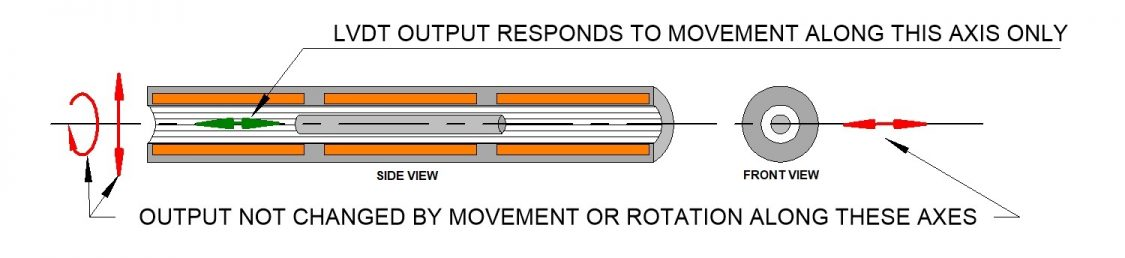
7. Insensitivity to Cross-Axial Core Movement
Neither vibrations nor zig-zags will compromise measurement quality. The LVDT output responds very effectively to movement along the axis of measurement and is insensitive to movement along the other two axes. Ideal for applications where the measured member spins the core, causes slight misalignment, or where cross-axial vibration takes place, the LVDT delivers consistent measurements only along the intended axis.
8. On-Board Electronics Unnecessary
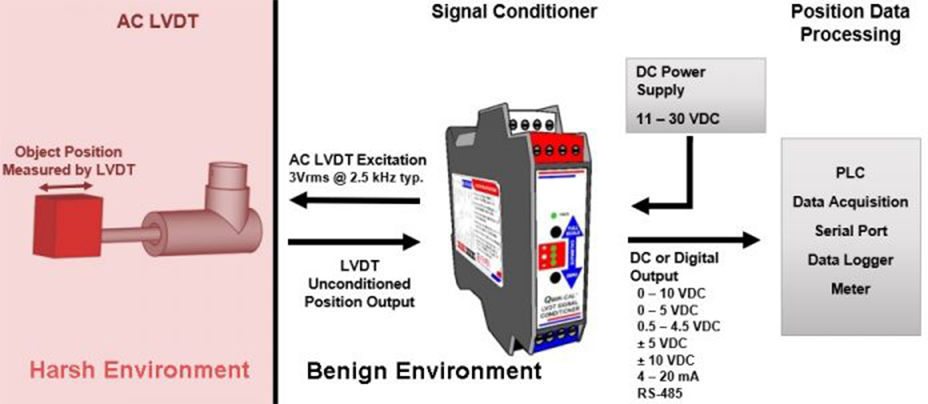
LVDTs can take a serious beating while in use, and the signal conditioner can be far away in safety. AC LVDTs can have their associated electronics mounted externally, so there is no need to have a printed circuit board (PCB) or other sensitive electronic components inside the housing. With the absence of a PCB, the LVDT can operate in areas with extremes in high temperatures, vibration, and pressures.
9. Absolute Output
LVDTs never forget where they are, even after months of power-down. Even through power cycles, LVDTs always deliver the true position unlike incremental sensors that must be re-homed after each power down. The true-position output through power cycles makes the LVDT ideal for long-term measurement applications like structural monitoring or critical measurement applications like a safety valve where errant readings due to loss of power can be very costly. It also allows the LVDT to be periodically awakened to make an accurate measurement then be put back to sleep where power budgeting is important.
10. Customization for Nearly Any Application
You name it, we'll make it! With a little engineering know-how, LVDTs can be customized for nearly any application or requirement. From small changes like custom wire lengths, pinouts, mounting features like flanges and construction materials for radiation or high temperature, to full developments for reliability targets, dual or triple redundancies, custom outputs, or corrosive environments, an LVDT can be made deliver reliable position feedback in nearly any application.